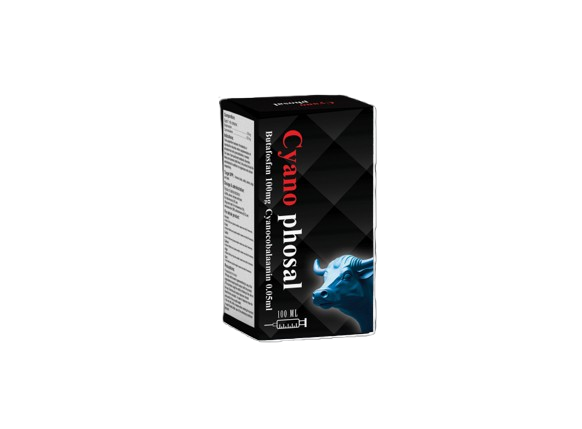
Cyanophosal
(solution for injection)
(For veterinary use only)
Composition:
Each 1 ml contains:
Butafospan ………………………………………………………………………. 100 mg.
Cyanocobalamin ………………………………………………………………………. 0.05 mg.
Properties:
Butafospan is an organic source of phosphorus that contributes to animal metabolism.
Among other things, phosphorus is essential for energy metabolism. It is necessary for gluconeogenesis, as most of the intermediates in this process require phosphorylation.
Direct pharmacological effects of butafospan, beyond mere phosphorus replacement, have also been proposed.
Cyanocobalamin
It is a coenzyme in the biosynthesis of glucose from propionate.
Furthermore, it acts as a cofactor for important enzymes involved in fatty acid synthesis, and is essential for maintaining normal blood formation, protecting the liver, preserving muscle tissue, maintaining healthy skin, and supporting brain and pancreatic metabolism.
Vitamin B12 belongs to the class of water-soluble B vitamins, which are produced by microorganisms in the digestive system of animals (reticulum and large intestine).
Vitamin B12 affects the metabolism of proteins, carbohydrates, and fats.
The precise mechanism of action of cyanocobalamin and butaphosphan together is not fully understood. Various effects of cyanocobalamin and butaphosphan combined on fat metabolism in cows have been observed in clinical studies, including reduced levels of ketogenic non-reduced fatty acids and serum hydroxybutyric acid. Indications:
1. As supportive therapy for metabolic or reproductive disorders when phosphorus and cyanocobalamin supplementation is required.
2. In cases of prepartum metabolic disorders, such as tetanus and paralysis (milk fever), the product is administered in addition to magnesium and calcium, respectively.
(solution for injection)
(For veterinary use only)
Composition:
Each 1 ml contains:
Butafospan ………………………………………………………………………. 100 mg.
Cyanocobalamin ………………………………………………………………………. 0.05 mg.
Properties:
Butafospan is an organic source of phosphorus that contributes to animal metabolism.
Among other things, phosphorus is essential for energy metabolism. It is necessary for gluconeogenesis, as most of the intermediates in this process require phosphorylation.
Direct pharmacological effects of butafospan, beyond mere phosphorus replacement, have also been proposed.
Cyanocobalamin
It is a coenzyme in the biosynthesis of glucose from propionate.
Furthermore, it acts as a cofactor for important enzymes involved in fatty acid synthesis, and is essential for maintaining normal blood formation, protecting the liver, preserving muscle tissue, maintaining healthy skin, and supporting brain and pancreatic metabolism.
Vitamin B12 belongs to the class of water-soluble B vitamins, which are produced by microorganisms in the digestive system of animals (reticulum and large intestine).
Vitamin B12 affects the metabolism of proteins, carbohydrates, and fats.
The precise mechanism of action of cyanocobalamin and butaphosphan together is not fully understood. Various effects of cyanocobalamin and butaphosphan combined on fat metabolism in cows have been observed in clinical studies, including reduced levels of ketogenic non-reduced fatty acids and serum hydroxybutyric acid. Indications:
1. As supportive therapy for metabolic or reproductive disorders when phosphorus and cyanocobalamin supplementation is required.
2. In cases of prepartum metabolic disorders, such as tetanus and paralysis (milk fever), the product is administered in addition to magnesium and calcium, respectively.
Target group: Horses, colts, cows, calves, dogs, and cats.
Dosage and method of administration
Cows, calves, horses, and foals: for intravenous use.
Dogs and cats: For intravenous, intramuscular, and subcutaneous use.
For full use
Horses:
0.02 ml – 0.05 ml per kilogram of body weight, repeated once daily as needed.
Foals:
0.033 ml – 0.056 ml per kilogram of body weight, repeated once daily as needed.
Cattle:
0.02 ml – 0.05 ml per kilogram of body weight, repeated once daily as needed.
Calves:
0.033 ml – 0.056 ml per kilogram of body weight, repeated once daily as needed.
Dogs: 0.025-0.25 ml per kilogram of body weight, repeated once daily as needed.
Cats: 0.1-0.5 ml per kilogram of body weight, repeated once daily as needed.
Warnings:
It is advisable to identify the causes of metabolic or reproductive disorders in order to determine the most appropriate measures for prevention and treatment, and to determine the need for treatment with phosphorus and vitamin B12 supplements.
Precautions:
Precautions for humans:
1. Individuals with a known hypersensitivity to any of the product’s components should avoid contact with the product.
2. The product may cause mild skin or eye irritation.
Therefore, contact with skin and eyes should be avoided.
In case of contact, rinse the skin and/or eyes with water.
3. Do not eat, drink, or smoke while using this product.
4. Wash your hands after handling the veterinary product.
Precautions for animals:
1. Use standard aseptic procedures when administering injections.
Quantities exceeding 10 ml should be divided and administered at separate sites, either intramuscularly or subcutaneously.
Precautions during pregnancy, breastfeeding, and egg laying
The product’s safety has not been established in cows, mares, dogs, and pregnant or lactating queens. However, its use during pregnancy and lactation in these species is not expected to cause any particular problems.
Contraindications
It should not be used in cases of known hypersensitivity to the active ingredients or to any of the excipients.
Drug interactions:
It should be avoided when mixed with other medications due to the possibility of incompatibility.
Side effects: Unknown.
Poisoning: Unknown.
Withdrawal period:
Livestock: Meat and milk: Zero days
Storage conditions:
Store at a temperature not exceeding 30 degrees Celsius, and use immediately upon opening.
Packaging
A cardboard box containing amber glass vials (type II) with an outer label containing a solution of 30, 50, 100, 250, 500, 1000 ml, sealed with a bromobutyl rubber stopper and an aluminum cap.
Manufactured by the Alexandria Pharmaceutical and Chemical Industries Company in Upper Egypt (UPE) for pharmaceutical industries.